Solar thoughts and design
Do not read. May contain errors. No guarantees, warranties, implied or express. I am not an expert.
Australian electrical standards related to solar.
[!] Australia, it is dangerous for safety standards to be for-profit i.e. hidden behind a paywall.
- AS 4509 Stand-alone power systems
- AS 4086 Secondary batteries for SPS
- AS/NZS 3000 Electrical wiring rules
- AS 1768 Lightning protection
- AS/NZS 1170.2 Wind loads
- AS/NZS 5033 Installation of photovoltaic (PV) arrays
Will Prowse
https://www.youtube.com/@WillProwse/videos
Very basic basics
Power (measured in Watts) = Voltage (measured in Volts) * Current (measured in Amperes or ‘Amps’).
The size or capacity of a solar system is expressed in kiloWatt (kW).
For DC power, Watt is the same as ‘VA’. For AC sine wave power, it is not. But that is a story for another time.
We are also interested in matching power demand / consumption with power supply / delivery ‘over time’ as in ‘per hour’, so we add this to the mix. Note panels, batteries, inverter input voltage (48Vdc), inverter output voltage (240Vac) are all fixed voltage; the system is effectively a fixed voltage variable current power supply:
Watthour (Wh) = Voltage * Amphour (Ah). As the Watthours exceed 1000 we express Watthours in kiloWatthours (kWh) for convenience.
What voltage to choose
Higher voltage = smaller cable gauge needed for same capacity. Choose wisely as can’t change easily afterwards. 48Vdc for domestic solar.
https://www.thesolarlab.com/how-tos/understanding-solar-battery-voltage
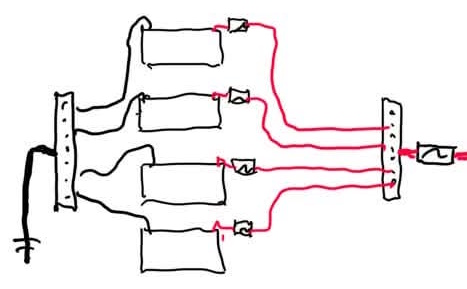
Equal length cables
Applies to parallel wired batteries and applies to cables of same type (between all positive, or between all negative). Typical symptoms one cable gets hot when others do not. Avoid inline fuses. Use bus bars when parallel wiring.
https://www.epochbatteries.com/pages/series-parallel
Short cable lengths
Applies to any high current DC cabling i.e. from batteries to inverter.
Class T fuse
https://www.epochbatteries.com/pages/what-is-a-class-t-fuse-and-why-it-matters-for-high-capacity-lithium-batteries
Batteries are effectively made in China, other countries are behind and effectively resellers. Quality fade is a culturally accepted practice.
https://www.youtube.com/watch?v=SVm5NpUD_KY
Note to self: Sodium battery technology
My concerns / thoughts:
– DC is a very different beast from AC. Expensive copper thick wire gauge. Proper cable lug crimping. Fire risk. Complexity. Insurance.
– High rate of innovation rendering existing setups lose value fast. Resale value of panels, batteries, inverter.
– Having a spare of everything. Two is one and one is none.
– More privately owned solar = less grid consumers = higher grid electricity prices + likely some sort of tax on solar / EV at some point (negative feed in tariff?) not ideal.
– Solar to charge an EV when EV is parked at work when the sun is shining not ideal.
– Charging an EV battery from a solar battery (DC to DC) not ideal.
– We need inverter because we need AC. DC domestic appliances matched to voltage of solar batteries would be nice but not going to happen.
– I would like EV batteries and solar batteries to be identical form factor and hot swappable. Not going to happen.